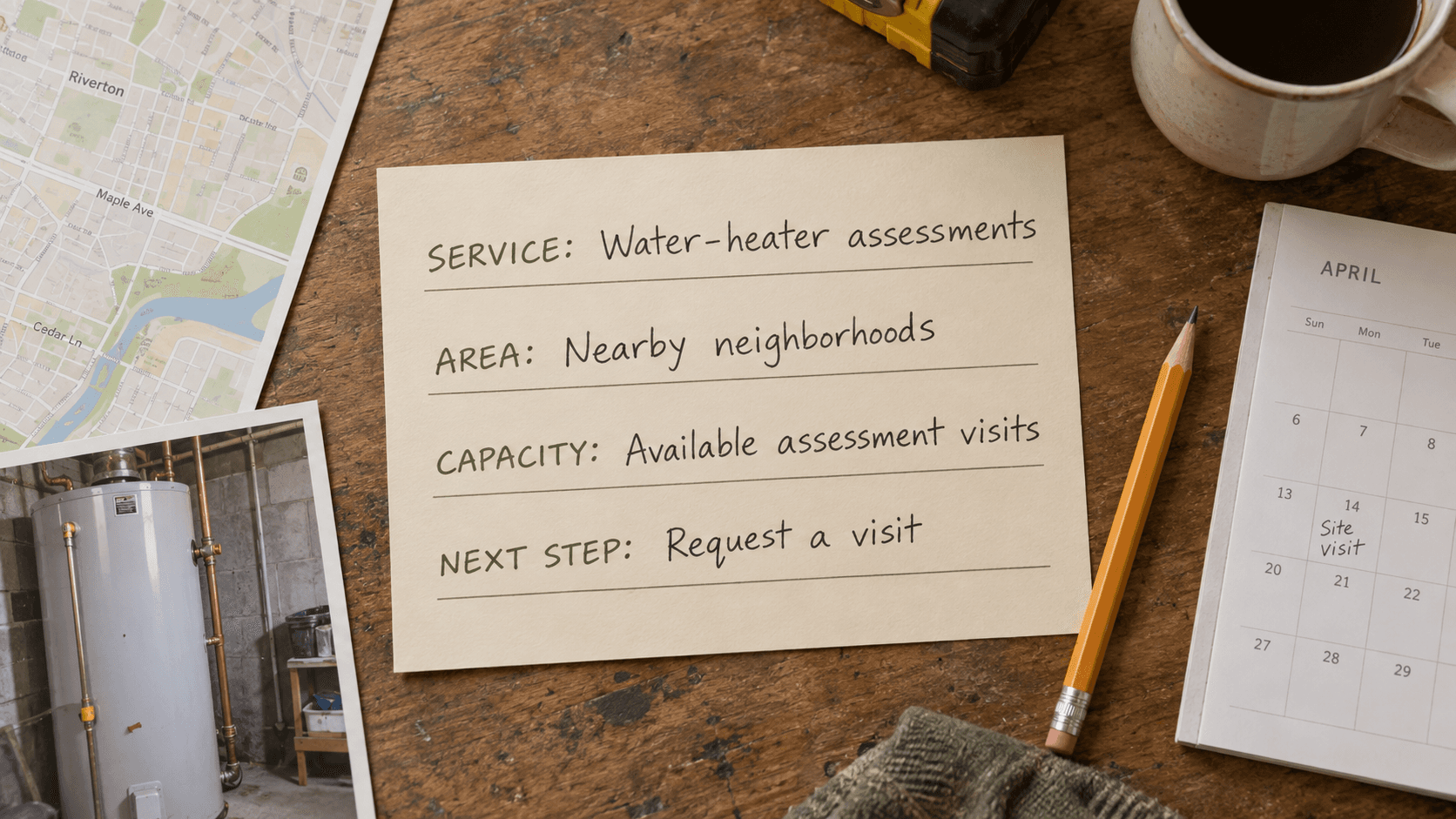
Local SEO for a home-service company starts with an accurate Business Profile and useful pages about the services and areas you genuinely cover. Help the nearby customer decide whether you fit their job, then make contacting or booking you straightforward.
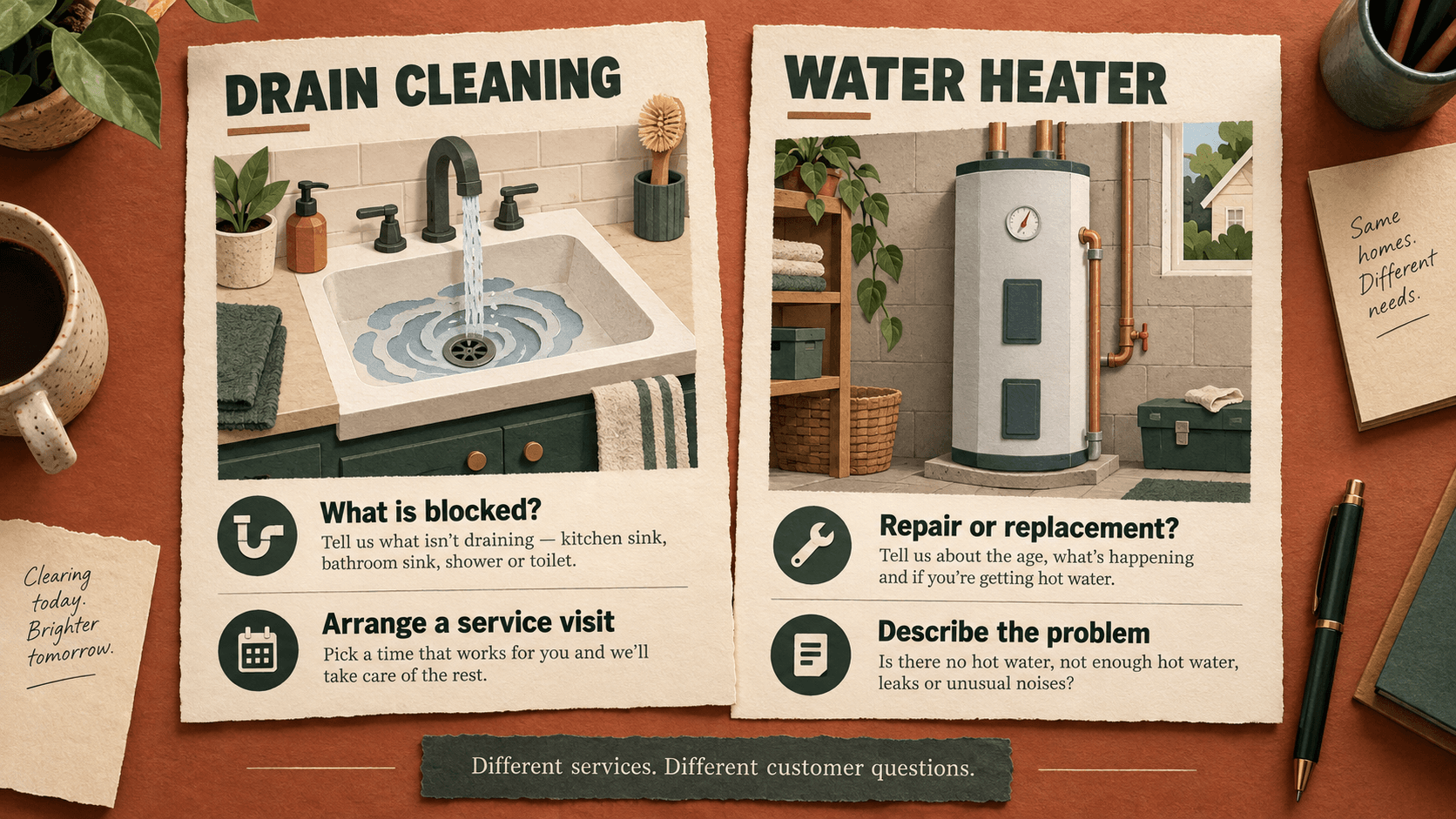
Publishing more pages is not the objective by itself. A page about emergency plumbing, a page about water-heater replacement, and a page about commercial service can answer different questions. Ten copies of one paragraph with different city names usually give the reader very little extra help.
Understand what the local result is trying to answer
Google identifies relevance, distance, and prominence as local-ranking factors. Complete information helps Google understand the business, but you cannot write your way out of the distance between your location and every searcher. Reviews and links can contribute to prominence; there is no published number of either that guarantees a position.
Start with the services and neighborhoods that matter to the business. Search results can vary by location and context, so do not judge the whole market from one search on the owner’s phone. Track the inquiries and work that follow discovery alongside any ranking report.
Correct the Business Profile before adding pages
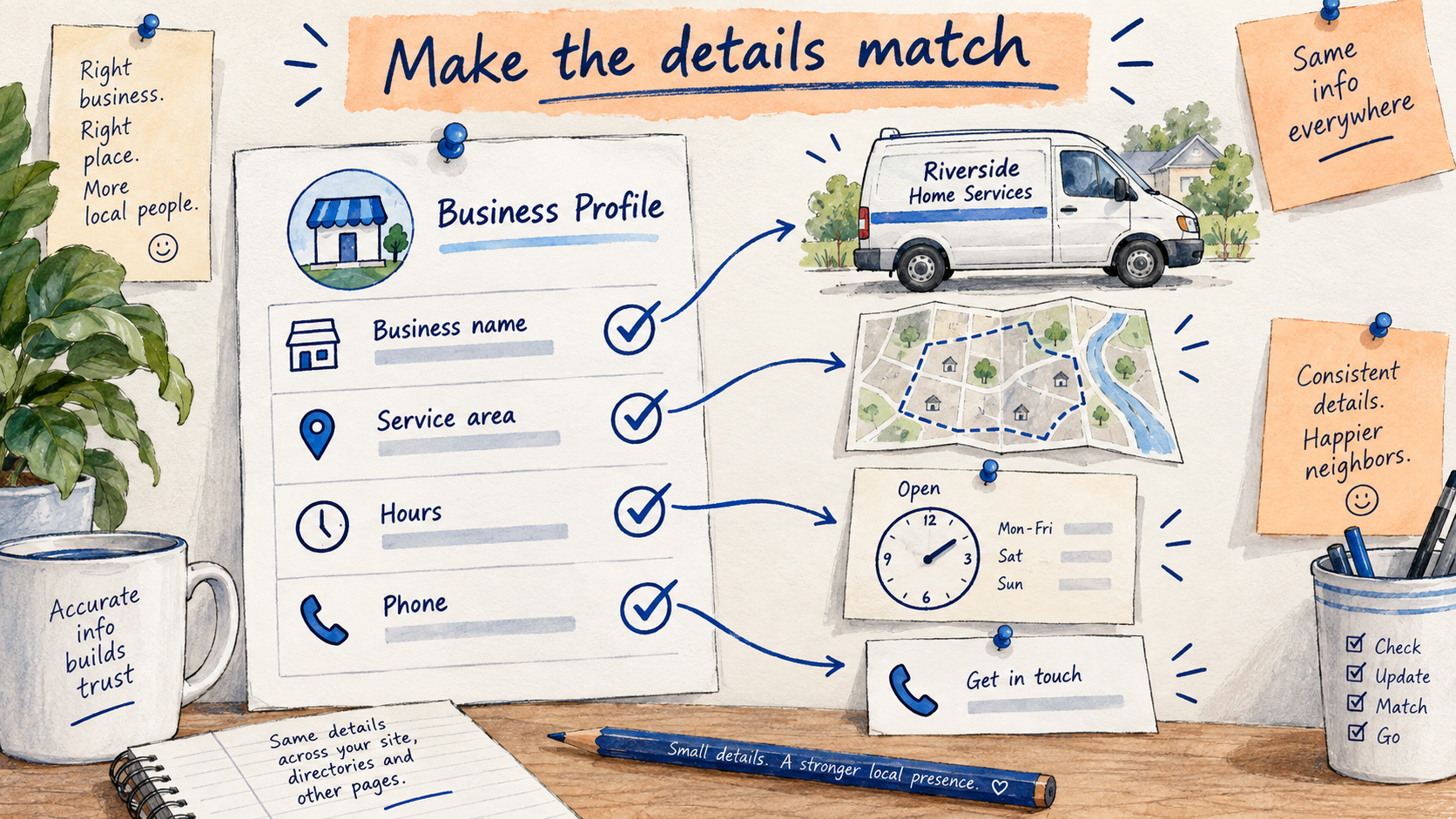
Review the business name, primary category, service area, hours, phone number, website, and the way the address is shown. Keep the information consistent with how the business actually operates. A contractor who visits customers has a different location situation from a staffed shop that receives them.
Google’s Business Profile guidelines distinguish legitimate locations from mailing addresses and virtual offices. Do not create profiles for places where the business does not actually operate as required. A service area on a website is not a branch office.
- Confirm who owns and can maintain the profile.
- Check every contact path from a customer’s perspective.
- Review regular and special hours against the coverage you actually provide.
- Add relevant, current photographs and service information.
- Assign someone to keep the profile current when details change.
Keep review requests honest and connected to real customer experiences. Respond helpfully to feedback. If a review reveals confusion about arrival times or service scope, use it to improve the customer path as well as the reply.
Build pages around different customer decisions
A good service page explains what you handle, where you work, how the first visit works, and what the customer should do next. Use the questions your callers ask to find missing explanations. A repeated question about whether you work on a particular system belongs on the relevant page.
| Page type | Content that earns a separate page | Weak reason to create it |
|---|---|---|
| Service page | Different work, assessment process, and customer questions | Another keyword spelling |
| Location page | Truthful coverage details and useful local evidence | Swapping the city name |
| Project guide | A real decision with options and a defined next step | Adding length around an advertisement |
| Comparison | Documented differences that help someone choose | Declaring yourself the winner without evidence |
Google’s spam policies address doorway abuse and scaled content created primarily to manipulate rankings. A useful editorial test is simpler: would this page still help the intended customer if search engines did not exist? If the answer depends entirely on capturing a keyword variation, consolidate it into a stronger page.
For trade-specific examples, see plumbing lead generation and marketing for electricians.
Use local proof without inventing it
Show actual work and explain what the example demonstrates. A project photograph becomes more useful when the caption identifies the type of job and relevant context. Obtain permission for customer details and avoid exposing private addresses or account information.
If you do not yet have publishable case studies, explain the process and answer real questions. Do not fill the gap with invented customers, fabricated revenue results, or stock photos labeled as your team. Readers need a clear basis for trusting the business.
Link related pages where they help someone continue a decision. A replacement page can link to an explanation of the assessment or a relevant project. Use descriptive text that tells the reader what they will find. Repeating a large block of every city and service beneath every article is a poor reading experience.
Make the answer easy for people and search systems to understand
Start with a direct answer, then explain the conditions and details. Use one clear page title, descriptive section headings, readable text, useful images with accurate descriptions, and a visible date when recency matters. Keep the important information in the page rather than only inside a graphic.
Google’s guidance for AI features says the established SEO practices still apply and that no special optimization or additional technical requirement is needed for those features. Accurate, accessible content is a sound foundation. A special file or an “AEO score” is not a promise that an answer engine will recommend your company.
For a question such as “Do I need an assessment for this project?”, give the plain answer and explain what changes it. Avoid writing a paragraph that repeats the service and city name before eventually addressing the question.
Track the customer path after the click
Make the phone number easy to use on mobile and keep request forms focused on details needed for the next step. Explain whether submitting the form requests a callback, requests an assessment, or confirms a booking. Those promises are different.
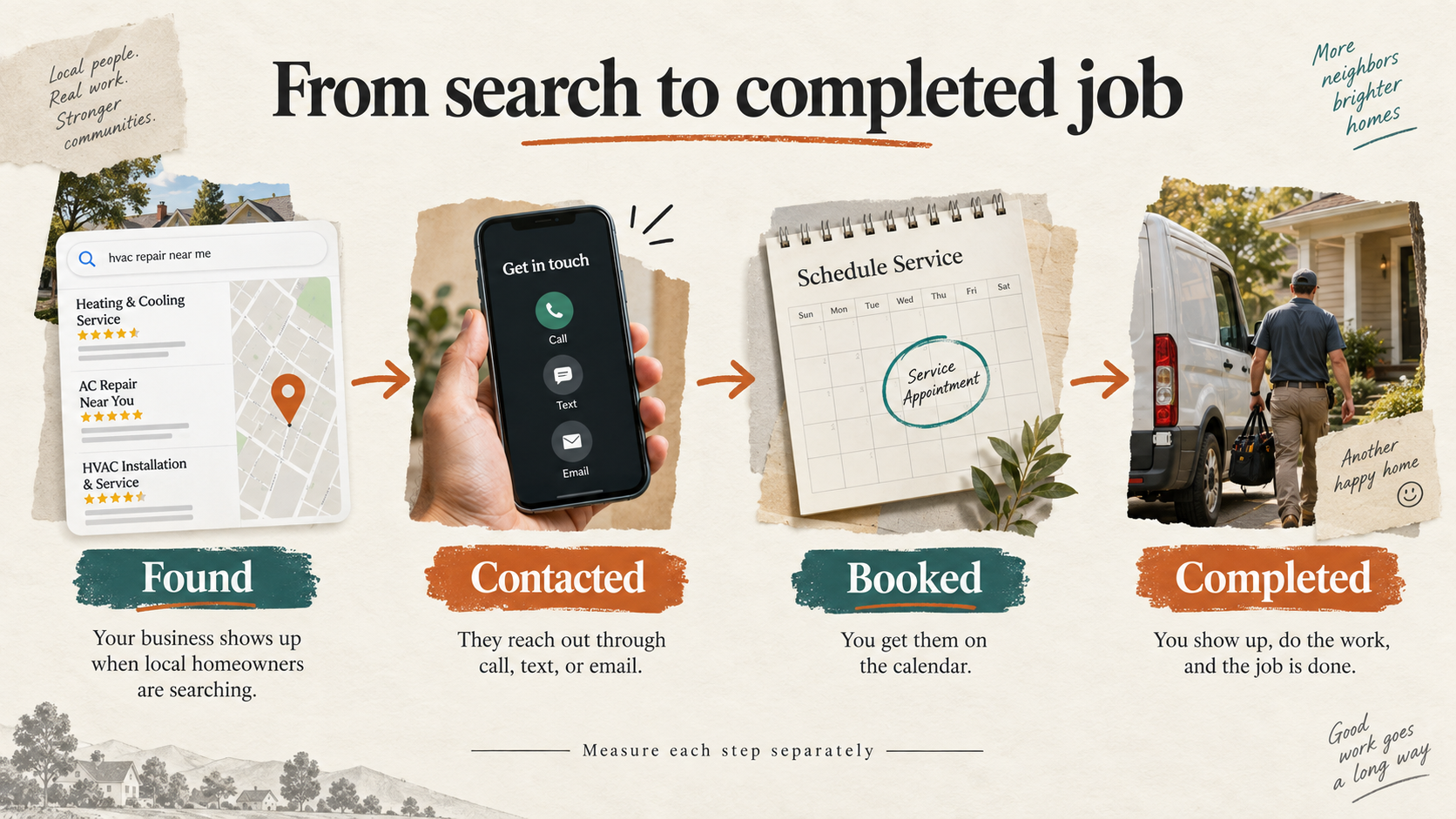
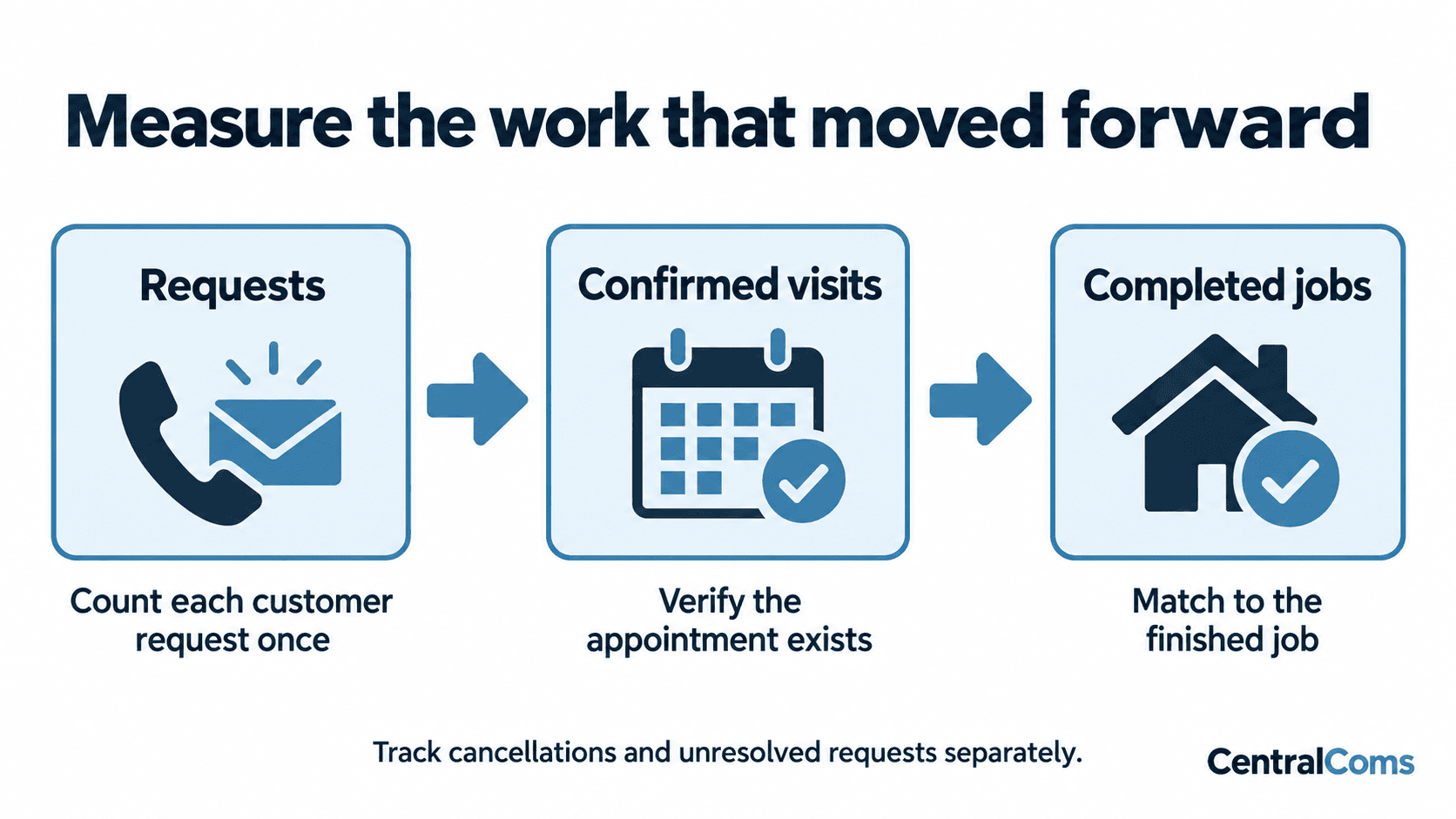
Connect organic inquiries to appointments and completed work using the call-tracking framework. Keep existing-customer support calls separate from new service opportunities. A jump in phone clicks may be useful, but it does not establish a corresponding jump in new jobs.
Run a useful monthly SEO review
Review which pages bring suitable inquiries, which customer questions remain unanswered, and which contact paths fail. Consolidate overlapping pages when they serve the same decision. Improve the pages customers actually use before adding another batch.
When a page performs poorly, inspect its purpose, search intent, content, and conversion path together. Low traffic and poor booking conversion require different investigations. SEO can help customers find you; the lead-conversion process helps turn that attention into a useful next step.
Frequently asked questions
How many city pages should a contractor publish?
There is no useful universal count. Create separate pages when you can provide distinct, truthful information for customers in those areas. Otherwise, a clear service-area explanation on a strong service page may be more useful.
Can we pay Google for better organic local rankings?
Google’s local-ranking guidance says there is no way to request or pay for better local ranking. Paid advertising is a separate channel. Keep those expectations separate when evaluating a marketing proposal.
Does AEO require different article formatting?
Direct answers, clear headings, contextual sources, and crawlable text help readers understand the page. They do not guarantee inclusion in an AI answer. Build useful content around the actual customer question and keep the technical SEO foundation sound.
Sources and further reading
Sources checked . Check current plans and documentation before choosing a service.