The cost of missed calls depends on how many were real opportunities, how many you could still help, and what completed work would have been worth. Start with a call-log audit. Multiplying every unanswered call by an average job value will usually overstate what a new answering service can recover.
Some missed calls are new customers. Others are repeat attempts, existing-job questions, spam, or callers outside your service area. They may still deserve attention, but they do not all represent a new sale.
Define “missed” before calculating a loss
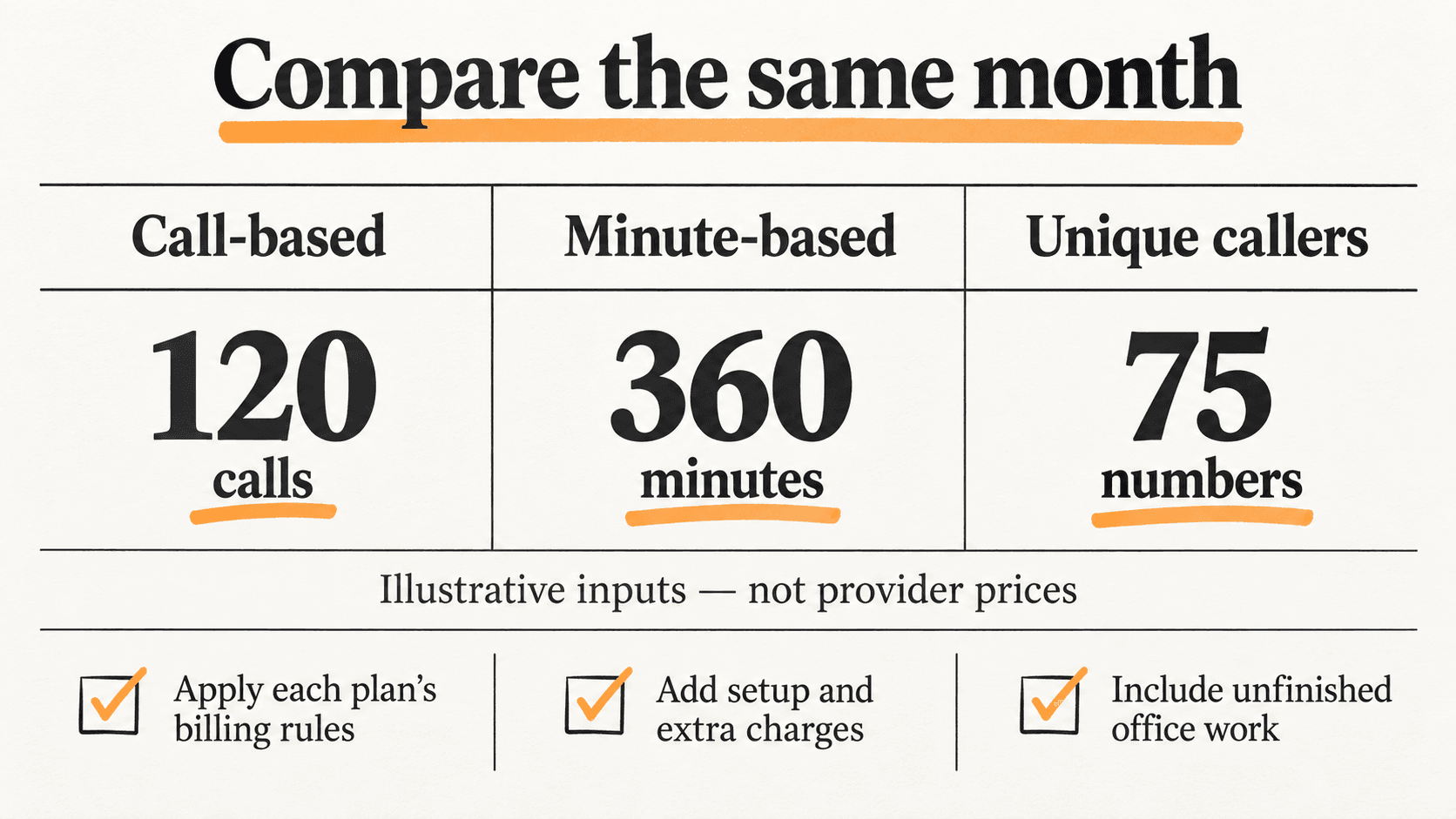
Phone systems can report unanswered, abandoned, voicemail, transferred, and answered calls differently. A call that reached an automated greeting may count as answered without producing useful help. A call transferred successfully may still fail at the receiving extension.
Invoca’s July 2026 home-services report says 52% of callers in its sample spoke with a person, rising to 65% for calls longer than 15 seconds. These are platform-customer averages, not a census of contractors. “Did not speak with a person” also does not automatically mean a lost job: the metric is not a measure of whether an AI completed the request.
Use the report to understand why definitions matter. Use your own call records to decide what happened at your business.
Audit the calls that did not reach a useful outcome
Review a representative period that includes open hours, busy periods, and evenings. Keep the original call events, then group repeat attempts from the same customer around the same request.
| Record | What it helps you decide |
|---|---|
| Arrival time and route | Whether the problem is concentrated by shift or line |
| New or existing customer | Whether it is a new opportunity or service responsibility |
| Requested work and area | Whether the business could serve the request |
| Outcome of later contact | Whether the customer was reached and helped |
| Booking and completion | Whether any recovery became finished work |
| Failure reason | Whether to change routing, staffing, coverage, or availability |
Google Ads call reporting provides details such as duration, time, and whether calls connected. Those details can support the audit, but you still need customer and job outcomes from your own process.
Use a recoverable-work model
Use distinct qualified opportunities as the starting point. Then apply assumptions you can test: the share you can reach, the share that will book a suitable visit, and the share that will complete the work.
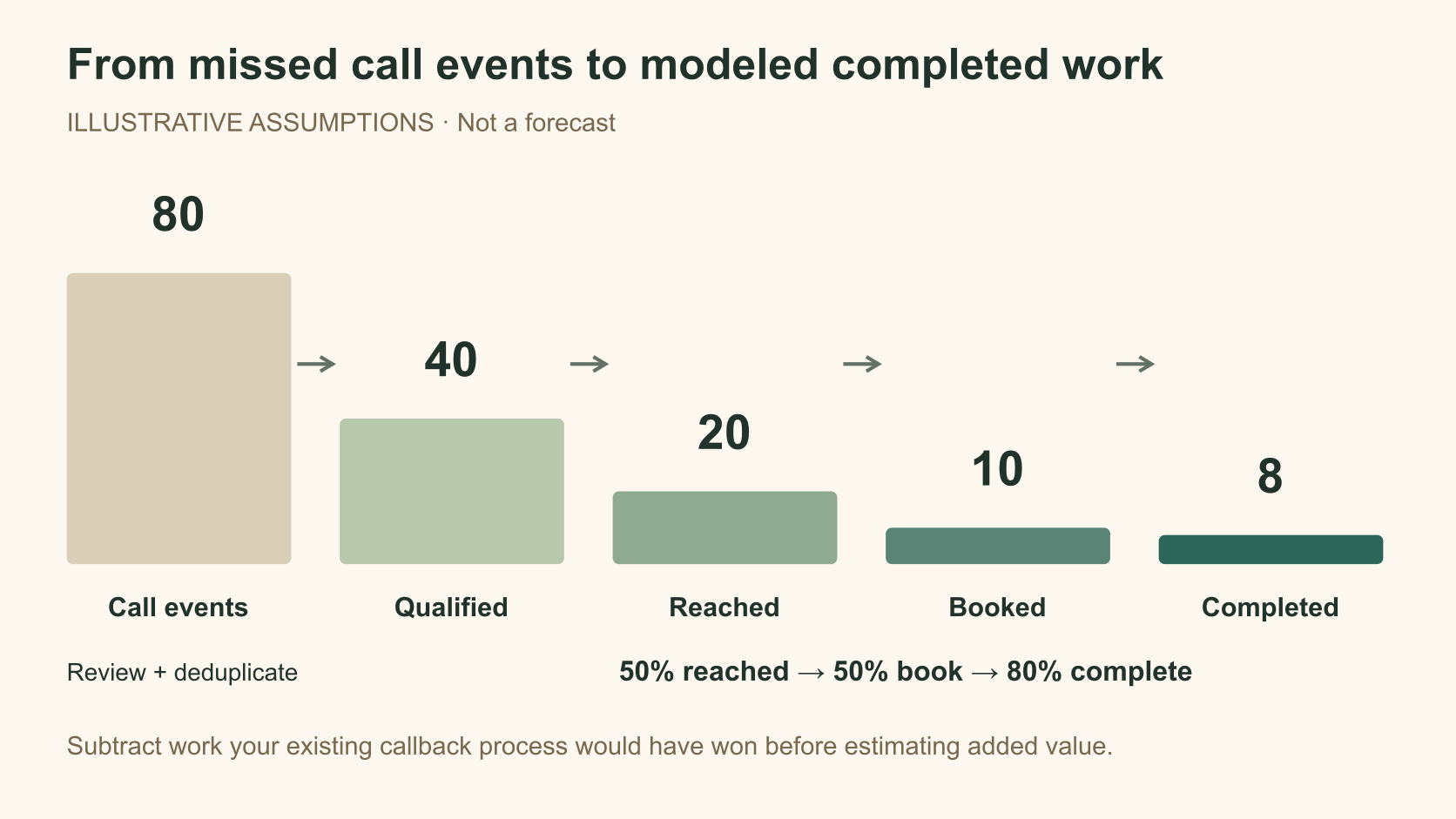
Illustrative example: 80 missed call events become 40 distinct qualified opportunities after review. Suppose you can reach half, half of those book, and 80% of the bookings complete. That produces eight completed jobs: 40 × 50% × 50% × 80% = 8.
At an assumed $500 of collected revenue per job, that is $4,000 in modeled completed work. It is not automatically additional revenue: some of those jobs may already have been won by your existing callback process. Subtract those jobs before estimating the improvement. Then subtract direct job costs and additional coverage costs to assess the financial benefit. Every input here is illustrative; replace it with your own records or clearly labeled assumptions.
Run a lower and higher case. If the result only works when almost every caller is reachable and every booking completes, the business case is fragile. Also check whether your team has capacity for the recovered work.
Choose the fix that matches the cause
| Cause found in the audit | Useful first fix | What to test |
|---|---|---|
| Wrong routing or a dead extension | Correct the phone configuration | End-to-end call from outside the business |
| Calls arrive together during open hours | Overflow coverage or staffing changes | Concurrent calls and a full queue |
| Inquiries arrive after closing | Defined after-hours answering | Next-day booking, callback, and on-call boundaries |
| Too many calls about basic information | Improve the relevant website page | Whether customers can find the answer |
| Answered calls still fail to book | Review intake, availability, and sales process | Correct next step for eligible callers |
A new provider will not solve a service-area mismatch or create installation capacity. Fix the cause you can identify rather than treating every missed-call pattern as the same purchasing problem.
Keep after-hours answering separate from dispatch
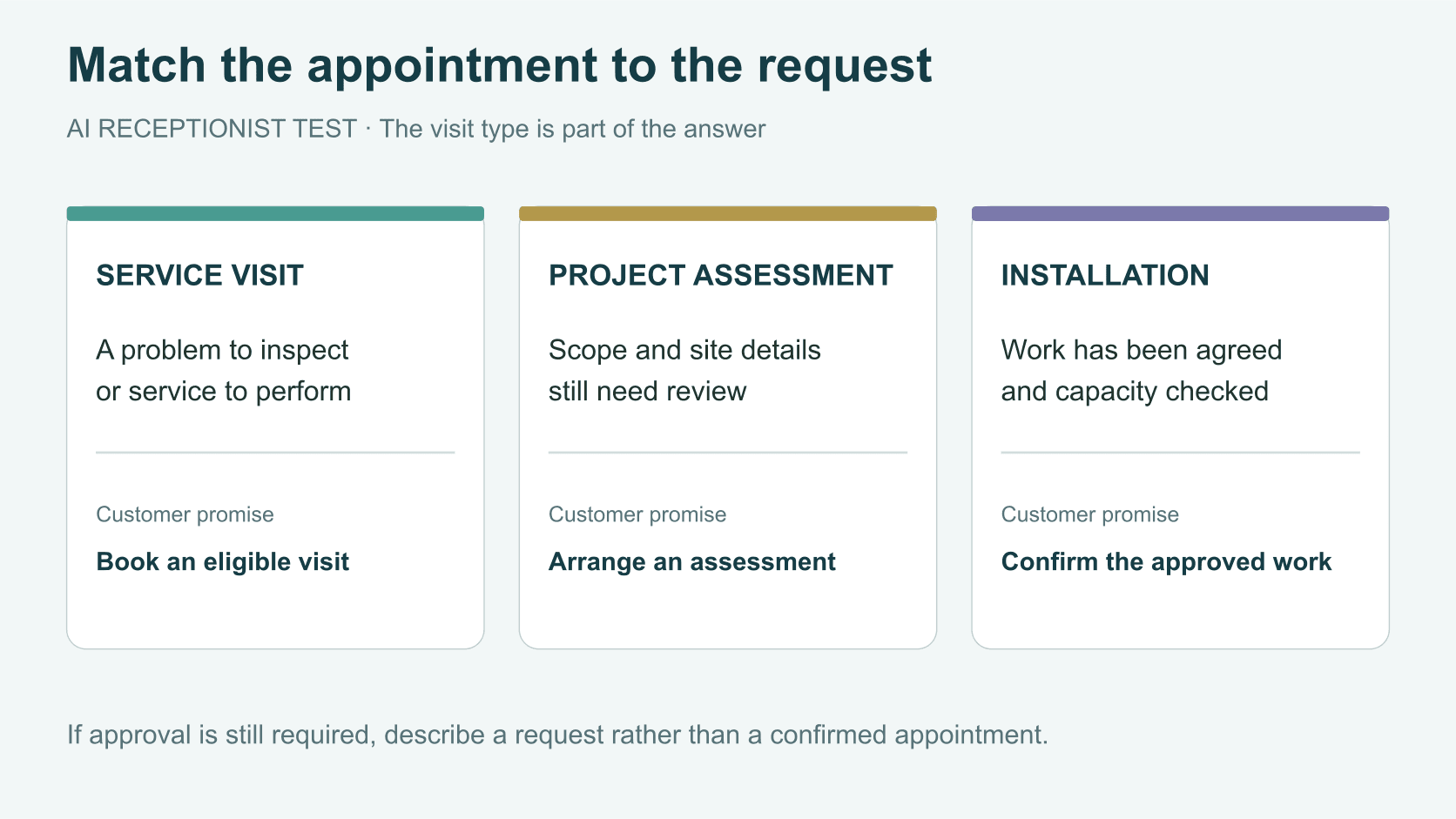
A business can answer at night without providing overnight field service. Decide whether it can book future visits, contact an on-call person, or collect a request for the office. The caller should hear which one applies.
Housecall Pro’s CSR AI settings document separate after-hours escalation choices. Whatever provider you use, test an unavailable on-call contact and a full schedule. Ask what happens to the unresolved request and what the customer hears next.
For a provider shortlist, see AI receptionists for home services. For a comparison of coverage models and their costs, see AI, live answering, or an in-house hire.
Review a pilot by completed help
Start with the coverage window where the audit found the clearest problem. Review the resulting conversations and records before expanding. Count correct appointments, useful callbacks, completed handoffs, duplicate records, and time spent fixing mistakes.
Compare similar periods and service types. Weather, promotions, staffing, and available capacity can change results. Report those changes instead of crediting the entire difference to answering coverage.
The lead-conversion guide helps measure what happens after contact. That is where you learn whether fewer unanswered calls are creating more useful customer outcomes.
Frequently asked questions
Can we calculate lost revenue from the missed-call count alone?
No. You need to identify distinct qualified opportunities and account for reachability, booking, completion, and job value. Keep assumptions visible and separate revenue from profit.
Does an answered call mean the problem is solved?
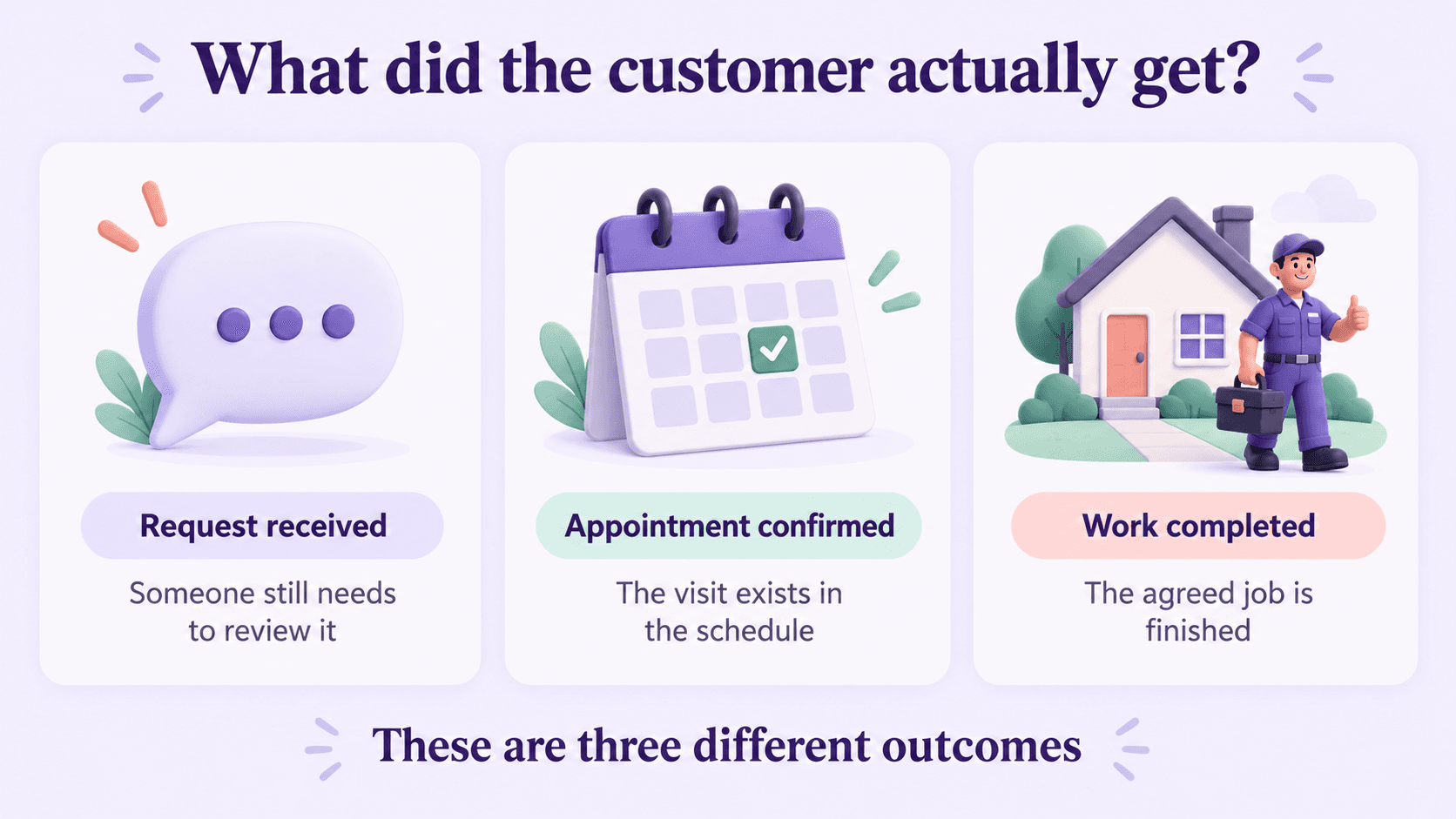
No. Review whether the customer received an accurate answer, a suitable booking, or a completed handoff. A greeting or transfer can count as answered in a phone report without resolving the request.
Should we advertise 24-hour service if we use an answering provider?
Describe the service you actually provide. Around-the-clock answering is different from overnight field attendance. Your website and call instructions should make that distinction clear.
Sources and further reading
Sources checked . Check current plans and documentation before choosing a service.